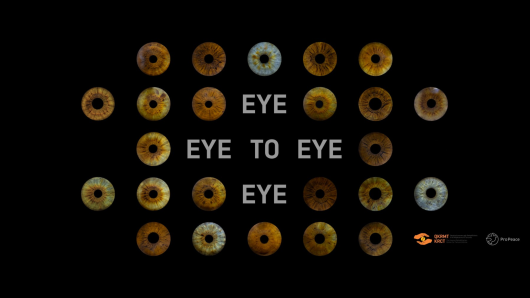
On 19 June 2026, as the world marked the International Day for the Elimination of Sexual Violence in Conflict, the Old Building of Prishtina Municipality opened its doors to an exhibition titled Eye to Eye.
Visitors encountered enlarged images of irises, alongside portraits and personal narratives, belonging to survivors of sexual violence during the 1998–99 war in Kosovo and to members of their families.
At the heart of the exhibition is a simple but demanding proposition: the gaze. Visitors were invited not only to look, but to allow themselves to be seen; to step out of the role of observer and into the stories unfolding before them.
The exhibition concept approaches the iris as more than a biological feature. It becomes a metaphor, a portal between inner and outer worlds, and a space for recognition, acceptance and confrontation. It is the point where a survivor's private experience meets the public gaze of society.
A dialogue at the center
At the center of the exhibition is a dialogue. Three survivors who have spoken publicly about their experiences, Vasfije Krasniqi Goodman, Ramadan Nishori and Shyrete Tahiri-Sulimani, face their own family members: Bahrije Mirena, Flutura Nishori and Vanessa Sulimani.
Around this core, the irises of other survivors, women and men, and of their family members widen the conversational space and draw the audience into it. Seen in a broader frame, the arrangement mirrors war experience, collective trauma, silence, and stigma that continues to shape the public's discourse.
This constellation highlights the role of familial solidarity in supporting and amplifying survivors' voices. It also invites reflection on postmemory and the ways in which the legacies of war are inherited, experienced and understood by younger generations.
“Look me in the eye”
For Feride Rushiti, Executive Director of the Kosovo Rehabilitation Centre for Torture Survivors (KRCT), the title says it all.
"We have titled this exhibition Eye to Eye because, when we want to tell someone the truth, we often say: look me in the eye," Rushiti said at the opening. “In the irises and testimonies on display,” she said, “visitors could meet not only pain, but also strength, fear, courage and hope.”
“Sexual violence,” Rushiti argued, "does not affect just one person. Its effects spread through families and communities, and the struggle for healing and justice continues decades after the war.”
According to Rushiti, the exhibition moved, with care, beyond the individual survivor. Their irises and portraits were joined by those of their family members, a reminder that conflict-related sexual violence leaves consequences that no one bears alone. Trauma, silence and stigma have lived on within families for years, and sometimes across generations.
A responsibility that did not end with the war
Then acting President of Kosovo Albulena Haxhiu placed the exhibition within a wider question of state responsibility. For her, the significance of Eye to Eye lies partly in what it refuses to do: reduce survivors to the moment of violence.
The stories, she said, also speak of the years that followed, years marked by silence, disbelief, judgement and fear. A society that seeks justice, she argued, must first learn to see survivors "with respect and gratitude" for the strength with which they have carried on with their lives.
Her message was also aimed at Kosovo's institutions. "Persons sexually abused during the war are part of our history and our state responsibility," Haxhiu said, adding that they should not remain at the margins of collective memory. "The Republic owes them recognition, care, justice and a life with dignity."
She also urged survivors who have not yet applied for recognition of their status to do so, pointing to the institutional support and reparations available to them.
In that sense, the exhibition became a space of asking what recognition, support and justice mean in the present.


Every iris is unique, as every story is unique
The international guests at the opening turned to another dimension of the exhibition: the relationship between artistic representation and testimony.
German Ambassador to Kosovo Rainer Rudolph described the iris scans and portraits as more than works of art. They are, he said, images of people who faced their perpetrators "eye to eye," and a powerful tribute to survivors of conflict-related sexual violence. "Every iris we see here is unique, as every story is unique," he said.
Making these stories visible matters, Rudolph argued, because sharing them can reduce stigma for individuals and for society as a whole. Progress, he stressed, cannot be measured by historical research and documentation alone, but by the support survivors receive today and by the stigma-free society built tomorrow.
British Ambassador Jonathan Hargreaves also focused on the act of looking. The images and testimonies, he said, bring the public "face to face, eye to eye" with the lived experiences of the people behind them. During his time in Kosovo, he had heard the same message again and again from survivors: they want to be heard, recognized and treated with respect.
Hargreaves described Kosovo's work on conflict-related sexual violence as impressive and, in several respects, an example for the wider world.
When the story passed to the families
Perhaps the most powerful intervention of the evening came not from an institution but from a family member.
Vanessa Sulimani, daughter of wartime sexual violence survivor Shyhrete Tahiri-Sulimani, spoke about the less visible burdens carried by children and families. She described herself as a "child of war" who was once traumatized, silent and unheard, and who gradually turned that pain into a determination to speak.
Her words challenged the habit of seeing survivors' families only through the lens of trauma. Children and relatives, she said, should be recognized as people who can also become agents of change. Society should stop behaving as though their eyes were not present when violence took place in front of them: they, too, witnessed it and its consequences, and they, too, carry memories that shape their lives.
The point was a call to look beyond labels, beyond "victim" and even beyond "survivor," and to hear family members as voices capable of shaping the future.
From Prishtina to Kukaj
When Eye to Eye closed at the Old Municipality Building on 8 July, it did not disappear. In August it travelled to Kukaj, a village roughly 25 kilometers east of the capital and home to Etno Fest, an annual festival that brings together theatre, music, visual arts, tradition and public debate. Etno Fest 2026, held from 3 to 10 August, placed Memory at the center of its program. There, the exhibition met a different kind of audience, one encountering it within a cultural festival rooted in village life and artistic practice.
Skender Boshtrakaj, Etno Fest host and former director of the National Museum of Kosovo, saw in it something that goes beyond documentation; “Eye to Eye transcends the character of a documentary exhibition. It creates an aesthetic and ethical experience in which individual memory enters into dialogue with Kosovo’s collective memory. The portraits and eyes do not seek pity, but recognition; they do not impose emotion, but invite reflection. Survivors are not defined solely by what they have experienced, but are presented as people with their own identities, personalities, and dignity.”
On 6 August, KRCT hosted a public discussion at the festival titled “Evidence, Dignity and Hope,” bringing survivors and the public together around the continuing consequences of conflict-related sexual violence. Kallxo.com described the exhibition and the discussion as a confrontation, “eye to eye,” with memory and pain that should not be forgotten.
Survivors Shyrete Tahiri-Sulimani and Ramadan Nishori spoke about the difficulties they faced before sharing their experiences publicly. Their message to other survivors was direct: seek help, report what happened and do not carry it alone. Telling his story, Nishori said, was the moment he began to live again.
Set alongside theatre, music and traditional culture, these testimonies placed the work of dealing with the past within a wider cultural landscape, and showed how hard, and how necessary, visibility can be.
The Kosovo Women’s Network described Etno Fest 2026 as a meeting point for art, culture, memory and stories that continue to matter to Kosovar society. In their public statement, the network noted that Eye to Eye created a space where memory shifted from something belonging only to the past into a dialogue about recognition, respect and social responsibility.
That shift matters. A memorial exhibition can stay within the familiar circles of institutions, civil society and people already engaged with transitional justice. When it travels, it meets people who may never have sought out a conversation about conflict-related sexual violence. That is one of the possibilities Eye to Eye opens up: the story comes to the audience.


Looking is not enough
The journey of Eye to Eye, from the Old Municipality Building in Prishtina to Kukaj, has been more than a sequence of venues. In Prishtina, the exhibition opened on a day set aside internationally to confront conflict-related sexual violence, and brought together survivors, family members, state representatives, diplomats, civil society and the public. In Kukaj, it entered the atmosphere of a festival built around memory and artistic expression, where testimonies sat alongside discussion, music and theatre.
In both places the central question was the same: what happens when a society looks?
The answer offered by the people behind Eye to Eye is that looking must be followed by listening. Listening must be followed by recognition. Recognition must be followed by dignity and justice. And memory, if it is to mean anything in the present, cannot be confined to anniversaries.
That may be the exhibition's most important journey: from seeing to acknowledging, and from remembering to taking responsibility.
The exhibition is another step in a longer process of documentation. Its stories draw on oral histories and on the publications, I Want to Be Heard (2017), Beyond Pain, Towards Courage (2021) and Unheard Voices (2024), produced by Pro Peace Kosovo and KRCT (and Integra for the first publication).
Explore the exhibition
The digital version of Eye to Eye (set at the Old Municipality Building in Prishtina) lets visitors encounter the exhibition beyond its physical venues: open the digital exhibition.
Eye to Eye was organized in partnership between the Kosovo Rehabilitation Centre for Torture Survivors (KRCT) and Pro Peace Kosovo, supported by the German Federal Ministry for Economic Cooperation and Development (BMZ), Heinrich Böll Foundation, British Embassy Prishtina, Kosovar Civil Society Foundation, Municipality of Prishtina, and Etno Fest.