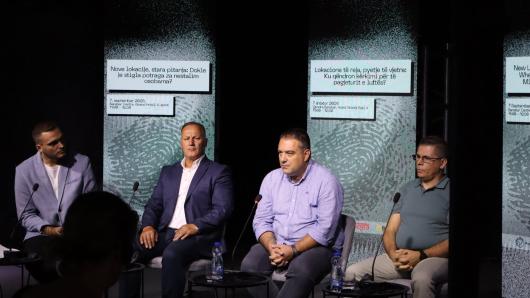
To mark the International Day of the Victims of Enforced Disappearances, the issue of Kosovo’s missing persons returned to public attention not as a memory but as an open wound that continues to shape the present. On the 7th of September 2026, in Prishtina, Pro Peace Kosovo and Integra, in cooperation with Barabar Centre, organized the public discussion “New locations, old questions: Where does the search for wartime missing persons stand?” The event brought together institutional representatives, family members, civil society actors, and journalists to reflect on the latest developments, the obstacles that remain, and the responsibilities that still have not been fully met.
The discussion took place at a particularly sensitive moment. Just weeks earlier, the discovery of human remains belonging to 23 persons in three locations in the Kalludër and Jabukë area of Zubin Potok had once again reminded the public that the search for the missing is far from over. What may have seemed like a technical development on the surface carried a deeply human weight beneath it: behind every set of remains there is a family that has waited for answers, often for decades, and a society still struggling to close one of the most painful chapters of the war. The findings were made possible through information provided by the Kosovo Police and the coordinated work of the Commission, the Police, the Prosecutor’s Office, and forensic experts. The process has now moved into anthropological examination and DNA analysis.
Yet the discussion made clear that recovery is not the same as resolution. The identification of human remains is only one step in a much longer moral, legal, and institutional journey. For families, the right to know does not end with the location of a grave or the confirmation of remains; it extends to understanding what happened, under what circumstances, and who is responsible. In that sense, the issue of missing persons remains one of the clearest and most demanding tests of transitional justice in Kosovo.
A recurring theme throughout the discussion was the tension between progress and limitation. Participants noted that the search process is still heavily shaped by the political climate and by the level of cooperation between Kosovo and Serbia. Despite the commitments made in 2023 and the establishment of the Joint Commission within the EU-facilitated dialogue, access to territory and archives in Serbia continues to stand as one of the main barriers to meaningful progress. The mechanisms are there, but the challenge lies in turning them into results that can be seen and felt by families.
The recent findings in Zubin Potok were presented as a rare but important example of what can happen when credible information reaches institutions and is followed through in a coordinated way. According to the discussion, the process of verification, excavation, exhumation, documentation, and forensic examination requires careful cooperation across institutions. It also requires patience, because the science of identification moves at its own pace, especially when samples are degraded or when further testing is needed. In such circumstances, the technical process can stretch into months, but the emotional waiting for families stretches much longer.
One of the most striking reflections emerging from the event was that institutional silence can be as painful as uncertainty itself. Participants discussed the need for communication that is regular, coordinated, and clear, but also cautious enough not to compromise investigations. Families should not be left to piece together their hopes and fears from fragments, rumours, or incomplete public statements. At the same time, institutions stressed that not all information can be shared at every stage. The challenge, then, is not simply to communicate more, but to communicate better, with timing, purpose, and sensitivity.
The families present in the room gave that challenge a human face. Their contributions underlined that communication is not an administrative detail, but part of the process of justice itself. Direct, respectful, and humane contact matters. So does preparation before visits to excavation sites, especially for those who carry years of accumulated grief and uncertainty. One family representative praised the cooperation with institutions, while others warned that partial or unconfirmed information can create false hope, deep disappointment, and retraumatization.
The discussion also turned to psychosocial support, a dimension that often remains visible only when a family is already overwhelmed. The Institute of Forensic Medicine said it has inherited a psychosocial support program for families of missing persons, with dedicated staff for communication and support. But panelists and civil society actors stressed that such support should not be treated as an auxiliary service or offered only at the end of the process. It should be accessible throughout, better known to families, and expanded beyond the municipalities where it currently operates. The burden of waiting, identifying, and learning difficult truths is not only legal or administrative; it is deeply emotional and often long-lasting.
Media and civil society were also recognized as essential actors in sustaining public attention and accountability. The media were commended for keeping the issue of missing persons in public debate, while also being urged to handle unverified information responsibly so as not to harm families or undermine investigations. Civil society, meanwhile, was described as a bridge between institutions and families, with an important role in information-sharing, organizing meetings, offering support, and monitoring commitments. One encouraging note was the cooperation among families from different communities, showing that the search for the missing can also become a space of solidarity across ethnic lines.
Several clear conclusions emerged from the discussion. The first is that the search must continue with urgency, because new information can still lead to concrete results, even after many years. The second is that access to documentation and archives, especially in Serbia, remains indispensable, and the commitments made in 2023 need to be judged by actual outcomes rather than declarations alone. The third is that families must be placed more firmly at the centre of the process, not only as recipients of information but as rights-holders whose dignity must guide every institutional response.
The recommendations that followed were practical, but they also carried a wider moral message. Institutions should strengthen and regularize communication with families, expand psychosocial support, train officials in trauma-sensitive communication, and ensure that all missing persons are treated equally, regardless of ethnicity, religion, political affiliation, or wartime status. The media should continue reporting, but with care and verification. Civil society should keep acting as a bridge. And identification, however important, must be followed by investigation and accountability where evidence exists, because the right to know is incomplete without the right to justice.
In the end, the discussion showed that the question of missing persons is not only about the past. It is about the kind of society Kosovo is still trying to become: one that can face its history with honesty, treat families with dignity, and build institutions capable of turning information into justice. The new locations in Zubin Potok brought fresh hope, but they also reopened old questions. And until those questions are answered, the search remains unfinished.
A comprehensive report, prepared by journalist Fisnik Minci, documenting the key discussions, findings, and recommendations from the event will be published shortly. The report will be shared with key stakeholders, including associations of families of missing persons, media representatives, public institutions, international organizations, and other relevant actors.


