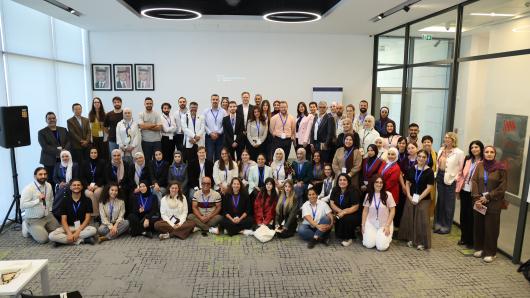
For the past three years, Pro Peace Jordan, GIZ Civil Peace Service and Agiamondo, together with their local partner organizations, have jointly marked the International Day of Peace in Jordan. While we share a commitment to peacebuilding, our work takes place in different communities and contexts, using different approaches shaped by the realities we encounter. Coming together creates an opportunity to bring that knowledge into one space—to exchange experiences, learn from one another and find connections between work that might otherwise remain within separate projects and networks.
This year, under the theme “Invest in Peace – for Everyone, Everywhere, Every Day,” we wanted that exchange to be at the center of the day. And the idea of investment provided more than a theme for the event; it raised a question that accompanied the conversations throughout the day: what does invest in peace actually look like?
Speaking on behalf of the German Federal Ministry for Economic Cooperation and Development, Mr. Jonas Lucas, the Development Counsellor at the German Embassy in Jordan offered one answer:
“Like any investment, peace requires patience. It rarely shows immediate returns, and often results of an investment in peace remain invisible. But it is the investment that matters most in the long run.”
His words reflected much of what was being explored throughout the Peace Day. Peacebuilding is rarely a process where change can be captured through one activity, one event or one result. Much of it happens gradually—through relationships strengthened over time, spaces where people can speak and listen to one another, and local actors who continue doing the work long after an event has ended.
That understanding also shaped the way the day itself was designed. Instead of filling the programme with presentations about individual organizations and their achievements, we chose to make room for conversation. Participants came together around different areas of peacebuilding work, bringing with them the realities of the communities they work with, the challenges they have faced, the approaches they have tested and the lessons they have learned along the way.

Some experiences were different. Others felt surprisingly familiar. And somewhere between sharing what worked, being honest about what did not, and listening to how others were navigating similar challenges, the conversation became about more than individual projects. It became about what could be learned from one another.
This was also reflected in what participants carried away from the day. Some spoke about the importance of thinking together, building relationships and directing their efforts towards their communities. Others highlighted how listening to different perspectives can strengthen dialogue and critical thinking. Their reflections pointed to something simple but important: exchange is valuable not because everyone leaves thinking the same way, but because they leave having encountered perspectives beyond their own.

A challenge one organization is still navigating may be something another has already encountered. An approach that worked in one community may open a new way of thinking about a similar issue somewhere else. And sometimes, simply hearing how someone else approached a familiar problem is enough to look at your own work differently.
In many ways, this kind of exchange is already happening beyond the Peace Day itself. Our partners collaborate, their networks overlap and relationships often connect work that may look separate on paper. Hopes for Education, Training and Development, which works with the community in Jerash Refugee Camp, is one example. Through its partnerships with different actors within the Civil Peace Service, Hopes draws on different approaches and experiences while bringing its own knowledge of the community into those relationships. The value is not simply in having more partnerships, but in what becomes possible when what is learned through one relationship can inform another.
The joint Peace Day builds on that same idea. It gives existing relationships another space to grow and new ones the chance to begin—a space to exchange what has been learned, discover where experiences connect and carry something from those conversations back into the work.
For Walaa Qundos from Athar Association, a Pro Peace partner who has participated in all three joint Peace Days, this is part of what has made the experience meaningful:
“Each year brings different conversations, people and perspectives. What stays with you is not only what happens during the event, but the relationships you build and the ideas you take back to your own work. It reminds us how much we can learn from one another.”
And perhaps the most important part is where those ideas go next.
Because ultimately, collaboration between organizations is not an end in itself. Its value is in what it allows us to do better for the people and communities at the center of our work. When an experience shared during the Peace Day changes how we think about a challenge, introduces us to an approach we had not considered, or connects us to someone whose experience complements our own, that exchange has the potential to travel much further than the conversation itself.
This is where the different perspectives represented at the Peace Day began to meet. From the level of international cooperation, Lucas spoke about investing in people and partnerships rather than arriving with ready-made answers, recognizing that local actors understand the realities, challenges and opportunities within their communities. From within those communities and organizations, participants spoke about relationships, dialogue, listening and learning from perspectives different from their own.
Different positions, but a remarkably similar understanding of where peace begins.
As Lucas put it:
“We believe that lasting peace and social cohesion grows from within societies.”
The experiences shared by local partners throughout the day gave that idea a practical meaning. If peace grows from within societies, investing in peace means investing in the people and relationships that hold those societies together—in their ability to listen, to disagree without disconnecting, to learn from one another and to carry those lessons back into their communities.

One participant took that idea even closer to the individual level, reflecting that in order to help others, we must also invest in our own inner peace. It was a personal observation, but one that added another layer to the same conversation. Peace can be discussed at the level of international cooperation, organizations and communities, but it is also practiced through the way individuals listen, communicate, respond to differences and relate to one another.
Perhaps this is what “for everyone, everywhere, every day” looks like in practice.
It moves between levels. From international commitments to local organizations. From organizations to communities. From communities to relationships between people. And sometimes, back to ourselves.
Not every meaningful connection that comes from a day like this needs to become a formal partnership. Sometimes its value is quieter. An idea you take back to your team. A name you remember when a challenge comes up. A conversation that changes the way you look at something familiar.
These moments are difficult to capture in a photograph or place neatly into an indicator. But perhaps not everything that matters can be measured at the end of the day.

The joint Peace Day is one moment in a much longer story of collaboration. After three years of coming together, what it continues to remind us is simple: there is space for different approaches, different experiences and different organizations in peacebuilding. In fact, our work can be stronger because of them.
We may work under different names and different logos, but the peace we are working toward is shared.
It belongs to all of us. And building it is something we do together.
Frieden fördern
Stärken Sie unsere Friedensarbeit besonders effektiv und nachhaltig – mit Ihrer regelmäßigen Spende.