
Yet experience from post-conflict and transitional societies increasingly demonstrates that transitional justice also functions as a forward-looking, preventive, and strategic security tool. Accountability for serious crimes, recognition of victims’ suffering, truth-seeking, and institutional reform are not only matters of justice; they are essential components of sustainable peace, societal resilience, and long-term security.
Against this backdrop, Pro Peace in Bosnia and Herzegovina hosted a panel discussion entitled Transitional Justice as a Security Strategy on 26 September 2025, as part of the Sarajevo Security Conference (SSC). The panel brought together leading international experts in transitional justice, peacebuilding, international law, and security policy to examine how justice mechanisms can contribute directly to conflict prevention and the maintenance of peace.
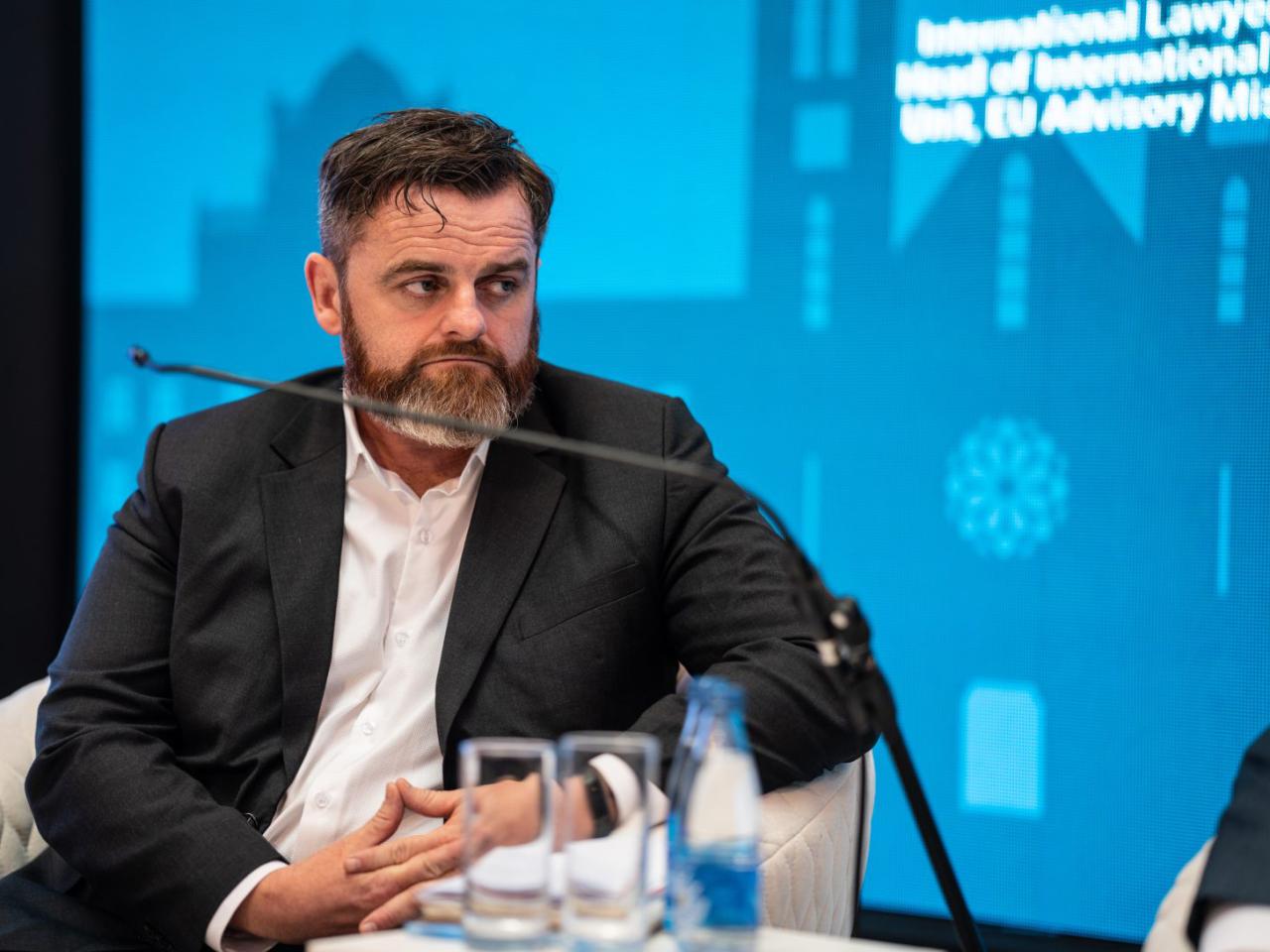
The panel featured Alexander Mauz, Chairman of the Executive Board of Pro Peace, as a featured speaker, alongside Aonghus Kelly, an international lawyer and former Head of the International Crimes Department of EUAM Ukraine; Paul Dziatkowiec, Director for Mediation and Peace Support at the Geneva Centre for Security Policy (GCSP); and Matthias Wevelsiep, Director of Programmes and the Operational Network at the Network for Religious and Traditional Peacemakers within Finn Church Aid. In my dual role as moderator and panellist, I contributed to the discussion from both a facilitative and analytical perspective, shaped by fifteen years of work alongside victims of war crimes in Bosnia and Herzegovina in their quest for justice and access to reparations.

The panel examined the role of transitional justice as a component of contemporary security strategies in post-conflict societies. It highlighted the central importance of transitional justice in fostering long-term security and stability, emphasising that sustainable peace cannot be achieved without meaningful engagement with the past.
While classic understandings of security adopt a state-centric lens, focusing on external and internal threats to the state, this concept has expanded over recent decades to place greater emphasis on the security of individuals. This broader understanding has been articulated as “human security”, notably in the United Nations General Assembly Resolution 66/290, which frames it as an approach to addressing threats to people’s survival, livelihood and dignity, and calls for “people-centred, comprehensive, context-specific, and prevention-oriented responses that strengthen the protection and empowerment of all people.”[1]
From this perspective, transitional justice advances both human security and human rights by addressing past violations, strengthening accountability, and implementing institutional reforms that reduce the risk of recurrence, thereby contributing to sustainable peace. At the panel, participants discussed a range of transitional justice mechanisms, including accountability for war crimes, reparations for victims, the strengthening of the rule of law, and the inclusion of local and religious actors in reconciliation processes. Particular attention was given to the relevance of these approaches in the context of Bosnia and Herzegovina.
Defining Transitional Justice
Transitional justice is a process that is closely interrelated with, and mutually reinforcing of “dealing with the past”. At times, the two terms are used interchangeably[2]; at other times, civil society organisations prefer to speak of “dealing with the past”, finding that “this term highlights even more the necessary transformation of society“ and that it represents a more comprehensive approach, focusing not only on political or judicial reforms, but also on “working towards changing attitudes, behaviours, and relationships”.[3]
Drawing on UN policy, transitional justice is understood not only as a normative framework for redressing serious human rights violations, but also as a forward-looking, strategic and pragmatic tool serving long-term goals such as prevention and the sustaining of peace.[4]
According to a United Nations definition from 2004, transitional justice refers to “the full range of processes and mechanisms associated with a society’s attempts to come to terms with a legacy of large-scale past abuses, in order to ensure accountability, serve justice, and achieve reconciliation“. [5] It further emphasises that “these may include both judicial and non-judicial mechanisms, with differing levels of international involvement (or none at all), and individual prosecutions, reparations, truth-seeking, institutional reform, vetting and dismissals, or a combination thereof“.[6]
Over time, the concept of transitional justice has evolved. Today, it is usually viewed through a holistic approach, entailing four main, mutually interconnected pillars that should form part of a comprehensive transitional justice policy:
- Truth-seeking – establishing and acknowledging past human rights violations (e.g., through the work of truth and reconciliation commissions).
- Criminal justice / accountability – the prosecution of perpetrators responsible for gross violations of international human rights law and serious violations of international humanitarian law.
- Reparations – a range of measures provided to victims, including material compensation for the harm suffered, various kinds of support, including psychological support, and symbolic measures like recognition of victims’ suffering, including through public apologies.
- Guarantees of non-repetition – institutional reforms, vetting processes, and social measures aimed at preventing the recurrence of violations. It is important to emphasise that the concept of guarantees of non-repetition extends beyond institutional reforms and vetting to include “measures in the social, cultural, and individual spheres“.[7]
Certain approaches sometimes expand this framework to five pillars, mainly by adding memorialisation as a separate pillar of transitional justice, while most adhere to the four-pillar division, in which memorialisation is viewed as one of the forms of reparations. It is also important to note that guarantees of non-repetition occupy a hybrid position within transitional justice frameworks: while legally classified as a form of reparations, and reparative in purpose (responding to victims’ rights, harm and needs), they are also treated as a distinct pillar, transformative in function (entailing institutional changes and preventing future violence).
- Challenge – Insufficient grasp of the transitional justice concept
Experience shows that the concept of transitional justice is often understood narrowly, and frequently perceived primarily through the lens of criminal justice. In practice, as illustrated by the example of Bosnia and Herzegovina, the absence of a well-considered strategic approach to transitional justice, combined with a limited understanding of its broader scope, can result in efforts to address the legacy of war becoming overly focused on criminal prosecution, while other essential measures receive less or no attention.
It is true that criminal justice is a very important component of transitional justice and can, on its own, contribute in various ways to the prevention of future violence. Yet conceptualising transitional justice in a comprehensive manner, and developing transitional justice strategies that pursue a holistic approach – making use of the full range of available tools to adequately confront the past, including truth-seeking, reparations, and guarantees of non-repetition – is of crucial importance for building sustainable, positive peace and enhancing security.
- Challenge – Limited prioritisation and the tendency to avoid transitional justice issues
Based on the experience of transitional justice and peace activists on the ground, one of the primary challenges in addressing the legacy of large-scale past abuses and ensuring meaningful impact through transitional justice measures is the failure to adequately recognise the societal importance of transitional justice. Even where such recognition exists to some extent, a further challenge concerns the priority assigned to transitional justice by domestic political actors, as well as by organisations such as the European Union and the broader international community. Such limited prioritisation can be observed at the global and regional levels, as well as within individual countries, and across a range of fora, including those devoted to security.
This is particularly evident in countries where peace negotiations are taking place, as the recognition of, and insistence on, the importance of transitional justice for ensuring sustainable peace and security, or the lack thereof, may directly influence the content of peace agreements and the broader societal dynamics that emerge from them in the medium or long term, including in the decades that follow.
This is also evident in post-war societies such as Bosnia and Herzegovina, where it has often been the international community’s political prioritisation of issues to be addressed through transitional justice measures that has most directly shaped local dynamics. In recent years, for instance, transitional justice has become a lower priority in this country, with immediate repercussions for the situation on the ground. During high-level meetings, issues related to specific political dynamics perceived as more pressing, such as economic development, frequently take precedence over the need to advance transitional justice demands. When this occurs, such prioritisation inadvertently reinforces the perception that no further action is required and that the status quo should be maintained, generating multiple negative repercussions of which relevant stakeholders are often unaware, or which they choose to ignore. A similar pattern can be observed in security-related discussions, where stability and risk management are frequently addressed in isolation, without due consideration of the long-term security implications of unresolved transitional justice processes. As a result, security policies may overlook how the failure to address past violations continues to fuel mistrust, social fragmentation, and latent instability. In the region of the former Yugoslavia, as noted in the 2023 Issue Paper on dealing with the past by the Council of Europe Commissioner for Human Rights, Dunja Mijatović, backsliding and “unfinished processes for dealing with the past have been shown to increase radicalisation and right-wing extremism”, producing “a climate of hate and division, reflected in the well-documented increase in hate speech, interethnic violence and intolerance”, as well as recurrent violent incidents against returnees and minority groups.[8] Mijatović concludes that this “instils fear and constitutes a major obstacle to peaceful cohabitation and trust”, and that prompt political responses are required “in order to avoid a return to mass violence to the region”.[9]
Civil society most often recognises these realities on the ground and has, as Alexander Mauz pointed during the 2025 Sarajevo Security Conference, been the driving force behind transitional justice, especially at times when state institutions deprioritise it. However, as Mauz emphasised, for long-term transformation to occur, civil society initiatives and expertise need to be translated into institutional frameworks. The prioritisation of transitional justice needs to be demonstrated through structural and strategic changes, including, but not limited to, “transitional justice units within ministries, civil servants tasked specifically with embedding these processes in security sectors, and mechanisms that ensure dealing with the past is not handled in an ad hoc or symbolic way, but as part of national and regional security strategies“.[10]

3. Challenge: The false dilemma between peace and justice
Closely linked to the challenge discussed above is the often-mentioned or implicitly invoked peace versus justice fallacy, based on the presumption or argument that certain (transitional) justice efforts might prove controversial, increasing intergroup tensions, and undermining peace. This frequently results in the deprioritisation or even avoidance of “sensitive” issues related to addressing past human rights violations.
During peace negotiations, a key question frequently arises: how to adequately address the widespread human rights violations that have occurred. Such negotiations sometimes involve discussions around amnesties and similar measures, and often bring to the surface tensions between the objectives of peace and justice.
Promoting a false dilemma between peace and justice can lead to a limited approach to transitional justice that prioritises short-term stability at the expense of comprehensive measures to confront the past.
At the 2025 Sarajevo Security Conference, Paul Dziatkowiec emphasised that conflicts typically originate in actual or perceived abuses and are often sustained by a sense of injustice. He argued that durable peace therefore depends on affected communities perceiving that justice has been served, while lamenting that transitional justice is increasingly sidelined in discussions on ending wars and in peace negotiations themselves, which tend to prioritise quick deals and short-term fixes over lasting solutions.[11]

Take, for example, the ongoing process in Ukraine. Kateryna Busol, from the National University of Kyiv, notes that some experts suggest at least temporarily setting aside justice in Ukraine to prioritise a quicker path to peace: “Many believe that for Ukraine to insist on judicial redress is unrealistic and should not be a precondition of a peace settlement. However, quite apart from the moral imperative, the reality is that peace will not hold unless justice – in the form of trials and reparations – is served.”[12] Busol argues that mitigating accountability efforts would run counter to victims’ “deep desire for justice“ and would “activate acute social discontent“.[13] She also points to the negative effects this would have on broader civic transformation in the post-Soviet region, arguing that an eventual democratic transition is impossible “without a profound reckoning with society’s role in these events, and its contribution to the creation of the environment that enabled them“.[14]
Turning to a post-conflict setting, similar arguments have frequently been invoked in Bosnia and Herzegovina. I recall speaking abroad, a few of weeks before the 2024 UN resolution on Srebrenica[15] was adopted, with international diplomats who informed me of ongoing, strong diplomatic counter-efforts to block its adoption by seeking to convince the global community that it would endanger peace processes. One could sense genuine suspicion and fear among diplomats that this might indeed occur.
I also recall speaking with a foreign diplomat based in Sarajevo a few days after the resolution had been adopted. He shared his concerns about the political consequences of such a step and about the “crisis” it had allegedly created. I took the opportunity to calmly reassure him that many forms of “crises” are constantly being created in Bosnia, coming and going all the time, and that this one, too, would pass within a matter of weeks, as it ultimately did.
One and a half years later, viewed in retrospect, it has become clear that the adoption of the UN resolution has not endangered peace processes. In the meantime, other developments have emerged that, at certain moments, appeared to threaten peace in Bosnia and Herzegovina in a far more serious manner.[16] And fortunately, the intense fears provoked within the country have also proved to be short-lived.
Contrary to the narrative that recognition of immense human suffering may endanger peace processes, symbolic reparation measures such as the adoption of the UN resolution have the potential to foster sustainable peace precisely because of the ever-present need of victims to see a societal response to their unbearable pain.
Some family members of victims of the Srebrenica genocide shared with me, in the aftermath of the adoption of the resolution, their sense that the support of the international community expressed through the UN forum has restored their belief in humanity and in the world as a just place. They also emphasised that they view this step as having an important preventive, and thus also protective, function.
If we wish to examine prevailing fallacies suggesting that the pursuit of justice somehow hinders peace, it is important to analyse episodes such as the one described here not only from a short-term perspective.

The four transitional justice pillars contributing to sustainable peace and long-term security
To understand the impact of the pillars of transitional justice on sustainable peace and security, it is necessary to adopt a broader, mid- and long-term perspective. When discussing security, we must look beyond short-term notions of stability and challenge an exclusive focus on avoiding politically induced crises. It is also essential to take into account intergenerational cycles of violence, which can only be properly understood through a meta-perspective extending over several decades or longer.
Truth-seeking
In light of the need to draw lessons from history through a long-term lens, let us consider the example of the executions of collaborators with fascist forces in the newly established Yugoslavia at the close of the Second World War. In the decades that followed, a practice of silencing the true circumstances surrounding the deaths of family members – as well as the wartime collaboration of those who survived – emerged in socialist Yugoslavia.[17]
Such practices of collective forgetting, fabrication, or selective representation of crimes in family narratives sometimes had a devastating impact on cycle of violence that continued into the 1990s, when descendants of these victims took up arms. These narratives were also frequently exploited by political leaders and nationalist elites to mobilise support for war or to legitimise aggression. Such patterns underscore the importance of accurately establishing and historically documenting the truth through transitional justice processes.
The right to truth entitles victims and their relatives, as well as the wider public, “to seek and obtain all relevant information concerning the commission of the alleged violation, the fate and whereabouts of victims, and the extent to which the violation may have been officially authorised”.[18]
One of the key aims of the official acknowledgment of violations is to recognise victims’ experiences, rebuild trust, strengthen the rule of law, and promote social integration and reconciliation, thereby contributing to “ending cycles of resentment and mistrust”.[19] If left unaddressed, narratives of collective grievances, whether based on actual or perceived injustices and victimisation, may be exploited, including by terrorist or violent extremist groups.[20]
Apart from the most classic forms of truth-seeking, such as truth and reconciliation commissions like the one established in South Africa, there are numerous other mechanisms and approaches to recognising and validating the truth. The aforementioned UN resolution on the Srebrenica genocide represents a different form of truth-seeking measure: it provides formal, moral, and political recognition of the atrocities committed, serves as a measure of memorialisation, and satisfaction, affirming the rights and feelings of victims, and indirectly contributes to guarantees of non-repetition.
Other measures being employed include civil society-led truth-seeking processes. These can facilitate contact between former “enemy sides” and provide safe spaces for participants to listen to each other’s stories, step into one another’s shoes, and individuate even the “monolithic and deindividuated monsters”.[21] Such processes can also help to challenge rigid “Us/Them” dichotomies by fostering a shared goal that brings a novel, combined “Us” to the forefront[22], which may be rooted in a shared sense of victimhood while still acknowledging each participant’s personal experience.
Speaking on the panel at the 2025 Sarajevo Security Conference, Matthias Wevelsiep warned that patriarchal gatekeeping of memory in many contexts continues to shape whose suffering is recognised and whose voices are amplified. He argued that a security-smart transitional justice strategy must therefore pluralise memory and centre survivors; failing to do so erodes trust, reproduces exclusion, and perpetuates cycles of grievance. Within this framework, he highlighted the distinctive role of religious and traditional actors within broader civil society, noting that their social legitimacy enables access to spaces beyond the reach of the state and positions them to sustain medium- to long-term efforts aimed at truth-seeking, dignified reparations, and the socialisation of norms to prevent recurrence.[23]

Finally, truth-seeking mechanisms may also take the form of human rights commissions or fact-finding missions. Truth-seeking also encompasses efforts aimed at revealing the fate of missing persons, locating mass graves, and exhuming and identifying mortal remains. As Isidora Graorac, a representative of families of missing persons from Bosnia and Herzegovina, states: “I want every meeting to begin with the questions of the families of the missing. Because it is only if we put a full stop on that past that we can move forward. How can a parent move on if they haven’t found the remains of their child?”. [24]
Criminal Justice
Having explored truth-seeking as a means of uncovering past violations and promoting healing, it is important to turn to criminal justice – a traditional and well-known pillar of transitional justice – which pursues the truth in a different manner, through investigation, prosecution, and legal accountability for perpetrators within formal judicial procedures. Under the international law, states have an obligation to investigate, prosecute, and punish gross violations of international human rights law and serious violations of international humanitarian law.
Criminal justice has an important preventive function, given that “bringing alleged perpetrators to trial in accordance with fair trial standards, and seeing them adequately punished if convicted, helps strengthen societal trust and the rule of law“.[25]
In addition, criminal justice provides victims not only with the opportunity to witness justice being served – potentially offering a sense of satisfaction and catharsis, and thus fostering their healing process – but also diminishes the perceived need for personal retribution or the initiation of new cycles of violence. This is particularly important because it enables the individualisation of guilt, helping to tackle collective resentment and to prevent the repetition of collective violence against entire groups.
Speaking at the 2025 Sarajevo Security Conference, Aonghus Kelly emphasised that justice is a key part of soothing societies, allowing them to move forward after conflict and to flourish. While lamenting that history suggests this path is rarely taken, and that those released often neither repent of or even admit to their prior criminality, he argued that, in an ideal world, those convicted of atrocity crimes would serve lengthy sentences commensurate with their crimes. If and when released, they would have undertaken educational and rehabilitative programmes while incarcerated and would emerge as positive contributors to reconciliation in their home countries.[26]
According to Richard Goldstone, former Chief Prosecutor of the International Criminal Tribunals for the former Yugoslavia and Rwanda, peace is dependent on justice rather than the other way around.[27] As he emphasised: “I have no doubt that there cannot be peace without justice. If there is no justice, there is no hope for reconciliation and forgiveness, because those people don’t know whom to forgive. And they end up taking the law in their own hands, and that is the beginning of the next cycle of violence”.[28]
Bearing in mind the important functions of criminal justice, it is also important to note that, although questions of amnesties and leniency measures may arise during peace processes and in the design of transitional justice policies (as mentioned earlier), the position of the international community, as represented by the United Nations, is clearly opposed to them. While amnesties for other crimes (e.g. political offences related to resisting the state) may be permissible and, in some contexts, help lay a foundation for peace, amnesties for genocide, crimes against humanity, war crimes, or other gross violations of human rights are never acceptable.[29]
Reparations
Another vital pillar of transitional justice that is also essential for fostering sustainable peace is reparations.
For victims, meaningful justice encompasses much more than traditional, narrowly defined concepts that view justice solely or primarily through the lens of punishing perpetrators.
Most of the time, for justice to be satisfied, victims also need wider recognition of what happened and condemnation of the crimes within their communities. Memorialisation efforts therefore play important role. It is equally important for victims that judicially established facts about crimes are not denied and that war criminals are not glorified, which unfortunately occurs too often.[30]
When victims are acknowledged and supported through various forms of reparations – be it compensation, rehabilitation, restitution, or satisfaction – this can help heal wounds, rebuild trust in institutions, and reduce grievances that might otherwise fuel further cycles of violence. Unaddressed trauma resulting from mass human rights violations can be a significant risk factor for future violence, spanning across generations, sometimes over hundreds of years.[31]
An illustrative example is the situation of victims in Bosnia and Herzegovina, which offers important insights, not only in terms of notable achievements, but also in terms of painful lessons learned. Many victims continue to suffer today, living as though the war had just ended – as if it were still 1996. They were not adequately supported in the ways necessary to enable full healing.
Victims in Bosnia and Herzegovina therefore remain effectively unable to enforce their right to obtain redress for the harm they suffered during the war. The lack of meaningful progress on victims’ rights decades after the conflict, combined with rising hate speech, attacks on returnees, historical revisionism, and glorification of war criminals, creates a context that may pose a growing security risk, fuelled by the deepening frustrations of victims and their families. There are simply too many victims and families to ignore.
Renowned traumatologists such as Dr. Yael Danieli emphasise that multigenerational research consistently shows that both the process of redress and the realisation of justice are critical to healing – not only for individual victims, but also for their families, societies, and nations.[32] In this context, Danieli underscores reparative justice as an important tool enabling succeeding generations to “break the cycle of intergenerational transmission of hatred, rage, revenge, and guilt“.[33] She further argues that “impunity may contribute to a loss of respect for law and government, and to a subsequent increase in crime“, citing the example of Adolf Hitler’s attempt to annihilate the Jewish people, which was “emboldened by the world’s indifference to the Armenian genocide“.[34]
There is no “magic flight” towards reconciliation and sustainable peace. A genuine reconciliation process must also have a political and institutional dimension that addresses the systemic and ongoing factors contributing to the retraumatisation of individuals and groups.
For transformative peacebuilding to take place, we must, as Danieli aptly recognises, heal the sociopolitical context to enable full individual healing, while also supporting the healing of individuals in order to transform their sociopolitical environment.[35] Reparative justice, as a central pillar of transitional justice, is therefore fundamental to such a healing process and to breaking cycles of violence.
An effective way to adequately address the mentioned sociopolitical context is to adopt a comprehensive and strategic transitional justice approach – one that recognises that healing, justice, and peace must be built, not assumed.
Guarantees of Non-Repetition
While “truth seeking, criminal justice and reparations have preventive effects”, “the fourth pillar of transitional justice – guarantees of non-recurrence – is inherently forward-looking and refers to a core function, namely prevention, rather than to a specific measure”.[36] It encompasses a range of measures, with a typical focus on institutional reform. This may include security sector reforms through “increasing internal accountability and promoting effective civilian oversight“, as well as disarmament, demobilisation, and reintegration processes, and vetting to remove perpetrators from the sector.[37] Guarantees of non-repetition may moreover include “targeted steps in the areas of constitutional and legal reform, including those taken to ensure the compliance of emergency and security legislation with human rights, justice reform to enhance the independence of the judiciary, and the establishment of independent human rights institutions and ombudspersons”.[38]
Beyond these institutional measures, prevention also requires action at the societal level, including “repealing laws that limit civic space; fostering a free environment where civil society can advocate and network, alongside the promotion of anti-discrimination laws and policies; implementing legal empowerment programmes; adopting policies that protect and promote the rights to freedom of expression and association; and cultivating a free and independent media sector”.[39]
Finally, preventive measures in the cultural and personal spheres may include “aspects of formal and informal education, particularly the teaching of history (based on textbooks and curricula that acknowledge the abusive past, encourage critical and multiperspective thinking and affirm a commitment to human rights), interfaith dialogue, art-based and cultural initiatives to promote tolerance and social solidarity, memorialisation initiatives (to honour victims and create conditions for societal debate and dialogue on the causes and consequences of past abuse and the attribution of responsibility), and the maintaining and opening of archives“.[40]
Final Thoughts
Transitional justice should not be an afterthought in peace and security processes; it is an essential foundation for rebuilding trust, preventing future violence, and ensuring that peace is not only achieved, but sustained.
The absence of war is only the beginning of a long path towards true peace, a path that must focus on establishing the truth, enabling access to justice, providing reparations, reforming institutions, and offering meaningful acknowledgment.
This is where transitional justice mechanisms come into play. Transitional justice primarily refers to how societies address the consequences of widespread violence and human rights abuses. However, when conceptualised and implemented holistically and in a context-sensitive manner, it can also serve as a tool for democratisation and broader societal transformation. Transitional justice “must be understood as a cornerstone of security-building in post-conflict societies and states and institutions must embrace transitional justice as an integral part of their security architecture“.[41]
To conclude, there is no alternative to this: we cannot build the conditions for a secure, peaceful, and prosperous future without properly dealing with our past. Those engaged in transitional justice processes contribute to creating an environment that fosters truth, justice, mutual trust, and peace – and is therefore safer and more resilient to violence and hatred. In societies where past experiences of violence, or the narratives surrounding them, continue to shape the present, there is a significant risk that such narratives may be weaponised for political mobilisation and the incitement of new violence. For these reasons, in post-conflict societies, efforts to advance transitional justice cannot be ignored or sidelined in broader societal and policy conversations, indulging security considerations.
Adrijana Hanušić Bećirović was most recently a Senior Legal Adviser at TRIAL International, a non-governmental organization which fights impunity for international crimes and represents victims of war crimes in their quest for justice and reparation. From 2019 to 2021, she served on the UN Secretary-General’s Civil Society Advisory Board on prevention of sexual exploitation and abuse. Since 2016, she has been serving as a human rights consultant to the OSCE Mission in Bosnia and Herzegovina, and for the last ten years to various NGOs in Bosnia and Herzegovina and abroad, with a focus on international human rights standards, transitional justice, women’s rights, constitutional and anti-discrimination law. From 2010 to 2012, Adrijana spent her time in a law office, and provided in 2012 legal expertise to the B&H Parliamentary Assembly. From 2012 to 2013, Adrijana served as a UNDP legal expert to the National Human Rights Ombudsmen Institute. Ms. Hanušić Bećirović holds a Law degree from the University of Sarajevo and a French Master’s degree in Public International Law from the University of Strasbourg.
The blog was written for a regional platform on Dealing with the Past. For more information please visit the Column section of DwP website.
[1] UN General Assembly, Follow‑up to paragraph 143 on human security of the 2005 World Summit Outcome, A/RES/66/290 (10 Sept. 2012), para. 3.
[2] See, for instance, Alexander Mayer‑Rieckh, Dealing with the Past in Security Sector Reform, SSR Papers (Geneva: DCAF – Geneva Centre for Security Sector Governance, 2013), https://www.dcaf.ch/dealing-past-security-sector-reform, p. 64.
[3] “Interrupting the Cycle of Violence: How Pro Peace and Its Local Partners Address the Consequences of Armed Conflict Around the Globe”, Pro Peace, 9 June 2023, https://www.propeace.de/en/interrupting-cycle-violence.
[4] United Nations Secretary-General, Guidance Note of the Secretary-General: United Nations Approach to Transitional Justice, 2023, p. 22.
[5] United Nations, The Rule of Law and Transitional Justice in Conflict and Post-Conflict Societies: Report of the Secretary-General, UN Doc. S/2004/616 (23 August 2004), para. 8.
[6] Ibid.
[7] See, for example, the 2015 report of the Special Rapporteur on the promotion of truth, justice, reparation and guarantees of non-recurrence, which addressed guarantees of non-recurrence in particular (A/HRC/30/42), para. 32.
[8] Council of Europe Commissioner for Human Rights, Dealing with the Past for a Better Future: Achieving Justice, Peace and Social Cohesion in the Region of the Former Yugoslavia (Issue Paper, Council of Europe, 2023), p. 13.
[9] Idem.
[10] Alexander Mauz, remarks at Transitional Justice as a Security Strategy, panel discussion hosted by Pro Peace in Bosnia and Herzegovina, Sarajevo Security Conference, Sarajevo, 26 September 2025.
[11] Paul Dziatkowiec, remarks at Transitional Justice as a Security Strategy, SSC, 26 September 2025.
[12] Kateryna Busol, How to End Russia’s War on Ukraine: Safeguarding Europe’s Future, and the Dangers of a False Peace, Chatham House Report (London: Royal Institute of International Affairs, 2023), page 36.
[13] Ibid, page 38.
[14] Ibid, page 39.
[15] The resolution designates 11 July as the “International Day of Reflection and Commemoration of the 1995 Genocide in Srebrenica” and condemns any denial of that historical event and any actions that glorify those convicted of war crimes, crimes against humanity and genocide by international courts. United Nations General Assembly, UN Doc. A/RES/78/282 (23 May 2024).
[16] For instance, a crisis created following judicial developments related to the BiH Court finding former President of Republika Srpska Milorad Dodik guilty for not abiding by the General Framework Agreement of Peace. See, e.g., the Office of the High Representative, 68th Report of the High Representative for Implementation of the Peace Agreement on Bosnia and Herzegovina to the Secretary-General of the United Nations, October 2025.
[17] In an effort to protect themselves from stigmatisation, political repression, and social marginalisation, families often explained to younger generations that their relatives had “disappeared” or were simply “killed during the war”, while concealing the political or military affiliation of those family members, the identity of the perpetrators, or the political context of the deaths.
[18] United Nations Secretary-General, Guidance Note of the Secretary-General: United Nations Approach to Transitional Justice, 2023, p. 14.
[19] Ibid.
[20] United Nations, Report of the Secretary‑General on the Plan of Action to Prevent Violent Extremism, UN Doc. A/70/674 (24 December 2015), para. 35.
[21] Ibid, p. 629.
[22] Ibid, p. 627.
[23] Matthias Wevelsiep, remarks at SSC panel Transitional Justice as a Security Strategy, 26 September 2025.
[24] Isidora Graorac, president of the Organization of Families of Captured and Deceased Fighters and Missing Civilians of RS, cited in Adrijana Hanušić Bećirović, The Process of Searching for Missing Persons in BiH: 30 Years Later – What Next? [Proces traženja nestalih osoba u BiH: 30 godina poslije – kako dalje?] (policy paper, BIRN BiH – Detektor, Sarajevo, 2025), p. 36, https://detektor.ba/wp-content/uploads/2025/10/Proces-trazenja-nestalih-osoba-u-BiH-30-godina-poslije-%E2%80%93-kako-dalje_policy-paper_BIRN-BiH.pdf
[25] United Nations Secretary-General, Guidance Note of the Secretary-General: United Nations Approach to Transitional Justice, 2023, p. 16.
[26] Aonghus Kelly, remarks at SSC panel Transitional Justice as a Security Strategy, 26 September 2025.
[27] Richard Goldstone, “Interview with Judge Richard Goldstone” (1995) 5 Transnational L & Contemporary Problems 374, 376., cited in: Yael Danieli, “Massive Trauma and the Healing Role of Reparative Justice” in Reparations for Victims of Genocide, War Crimes and Crimes against Humanity: Systems in Place and Systems in the Making, edited by Carla Ferstman, Mariana Goetz, and Alan Stephens (Leiden & Boston: Martinus Nijhoff Publishers, 2009), pp. 41–42.
[28] Idem.
[29] Ibid, United Nations, The Rule of Law and Transitional Justice in Conflict and Post-Conflict Societies: Report of the Secretary-General, p. 17, and UN Doc. S/2004/616 (23 August 2004), para. 8.
[30] See, e.g., Adrijana Hanušić Bećirović, Das Opfer im Zentrum: Rechtliche Unterstützung von Überlebenden in Bosnien‑Herzegowina, in: RGOW – Recht Gut! / Recht und Gesellschaft in Osteuropa 2024, No. 6, pp. 13–15.
[31] See for example, Hamber, Brandon. Transitional Justice, Mental Health and Psychosocial Support: A Study of the Links Between Psychosocial Well‑Being, Reconciliation and the Implementation of Transitional Justice Mechanisms. Belfast: Democratic Dialogue, 2009, p. 8.
[32] Yael Danieli, “Massive Trauma and the Healing Role of Reparative Justice”, in Reparations for Victims of Genocide, War Crimes and Crimes against Humanity: Systems in Place and Systems in the Making, edited by Carla Ferstman, Mariana Goetz, and Alan Stephens (Leiden & Boston: Martinus Nijhoff Publishers, 2009), p. 42.
[33] Idem; Eduard Klain, “Intergenerational Aspects of the Conflict in the Former Yugoslavia”, in International Handbook of Multigenerational Legacies of Trauma, ed. Yael Danieli (New York: Springer, 2012), p. 293.
[34] Yael Danieli, “Massive Trauma and the Healing Role of Reparative Justice”, in Reparations for Victims of Genocide, War Crimes and Crimes against Humanity: Systems in Place and Systems in the Making, edited by Carla Ferstman, Mariana Goetz, and Alan Stephens (Leiden & Boston: Martinus Nijhoff Publishers, 2009), p. 43.
[35] Idem, p. 55.
[36] United Nations Secretary-General, Guidance Note of the Secretary-General: United Nations Approach to Transitional Justice, 2023, p. 20.
[37] Idem.
[38] Idem.
[39] Idem.
[40] Ibid, p. 20-21.
[41] Mauz, remarks at SSC panel Transitional Justice as a Security Strategy, 26 September 2025.