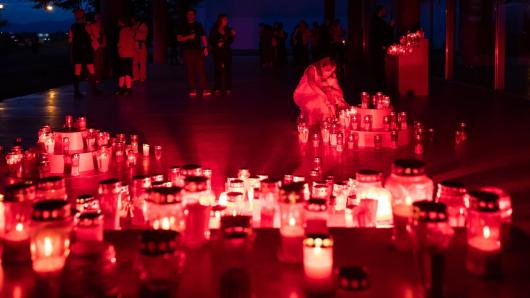
These questions shaped AWAKE, a site-responsive light installation by internationally acclaimed artist Šejla Kamerić, presented on 18 September 2026 at the Museum of Contemporary Art in Skopje as part of CRIC – Festival for Critical Culture.
Through light, shadow, and the atmosphere of a vigil, AWAKE invited visitors to reflect on the relationship between personal grief and collective vulnerability. Rather than focusing on a single historical event or offering a fixed narrative, the installation created space for contemplation, bringing individual experiences of loss and uncertainty into a shared public setting.
The installation encouraged audiences to consider how societies respond to suffering, particularly at a time when the repeated exposure to violence and crisis risks turning horror into an everyday reality. While the continuous flow of information can generate awareness, it can also lead to exhaustion, helplessness, and indifference. In this context, remaining attentive becomes an ethical responsibility: a refusal to accept violence and suffering as inevitable or to allow the experiences of others to disappear from public consciousness.
For more than two decades, Kamerić’s artistic practice has explored memory, identity, political responsibility, and the enduring consequences of conflict. Grounded in personal and historical experiences, her work connects intimate stories with broader social and political realities, creating opportunities to question established narratives and confront what is often overlooked or forgotten.
With AWAKE, this engagement takes the form of a quiet yet powerful invitation to collective presence. The installation does not demand agreement or offer easy answers. Instead, it asks visitors to acknowledge their shared vulnerability while making room for difference, uncertainty, and individual experience. Mourning becomes not only an expression of loss but also a way of recognising others and resisting the normalisation of violence.
The installation also reflects on the possibilities of resistance beyond loud gestures or direct confrontation. Acts of solidarity can emerge through attentive listening, mutual recognition, and the creation of spaces where people can encounter one another without erasing their differences. In this sense, care becomes more than a private feeling; it becomes a shared practice with social and political significance.
Presented within the 2026 edition of CRIC – Festival for Critical Culture, whose theme was “Care: The Challenge of Being Together Again,” AWAKE contributed to a broader exploration of what it means to rebuild connections and remain present with one another in uncertain times. By transforming the Museum of Contemporary Art into a space for reflection and collective remembrance, the installation invited audiences to consider how artistic practice can nurture empathy and sustain attention to the lives and experiences of others.
Supported by Pro Peace North Macedonia, CRIC’s programme reflects a broader commitment to fostering critical dialogue and creating spaces for engagement with difficult social and political realities. Through Kamerić’s work, art becomes a means of resisting indifference, acknowledging shared vulnerability, and imagining forms of togetherness grounded in care, responsibility, and respect.


